

Press Statement
SADC health ministers warn disruptive UNAIDS reform could jeopardize 2030 AIDS goal
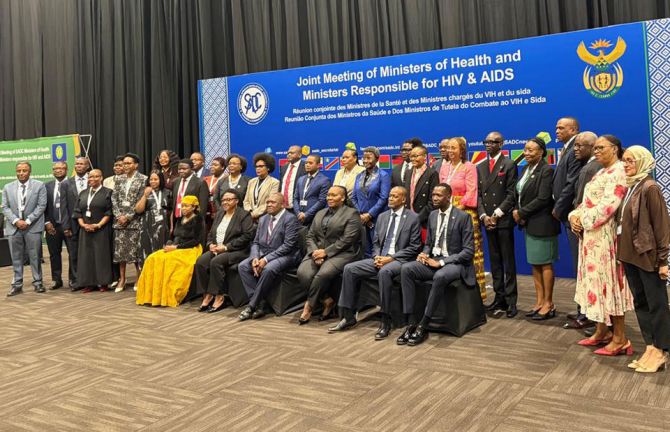
13 November 2026 13 November 2026GENEVA/DURBAN, 13 November 2026—Ministers of Health and Ministers responsible for HIV and AIDS from across the Southern African Development Community (SADC) have reaffirmed their strong support for the continued work of the United Nations Joint Programme (UNAIDS) during a meeting in Ethekwini, Durban in the Province of Kwazulu-Natal, South Africa, between 9-12 November. The health authorities are calling for reform that protects the institution's essential functions, including continued generation of strategic information and analysis that increases the understanding of the AIDS epidemic, expertise and ability to continue to support countries.
The health authorities underscored the indispensable role UNAIDS has played in shaping, coordinating and accelerating the regional and global HIV response during the Joint Meeting of SADC Ministers of Health and Ministers responsible for HIV and AIDS. The health authorities warned that any disruptive transformation of the UNAIDS Joint Programme could jeopardize hard-won gains in the global HIV response and undermine efforts to end AIDS as a public health threat by 2030.
Ministers called for the continuation of UNAIDS' lifesaving work in countries, emphasizing that its contribution extends far beyond institutional coordination. For decades, UNAIDS has provided the strategic information, evidence, political advocacy and technical support that countries need to develop effective HIV policies, mobilize resources and protect the lives and rights of people affected by HIV.
UNAIDS data remains central to understanding the epidemic and guiding the global response. Its strategic information has informed national policies, regional strategies, international negotiations and major global commitments. The agency's data and analysis have provided countries and development partners with the evidence needed to identify gaps, measure progress and direct investments where they are most urgently needed.
South Africa’s Deputy Minister of Health, Joe Phaahla, called for sustained domestic investment and continued international cooperation to protect progress in the HIV response across the SADC region. “The same principle applies to the future of UNAIDS. The gains made in the response to HIV and AIDS have been the product of extraordinary political leadership, scientific progress, community mobilisation and international cooperation,” said Mr Phaahla. “Those gains must not be put at risk by institutional uncertainty or declining resources. We must preserve the essential functions of coordination, strategic information, advocacy and technical support, while continuing to strengthen national ownership and sustainable responses. Our commitment to ending AIDS as a public health threat must remain firm.”
Ministers also recognized UNAIDS' critical role in ensuring that the HIV response is grounded in human rights, inclusion and community leadership.
In the SADC region, UNAIDS has helped transform the policy and institutional landscape of the HIV response at both regional and national levels. Through evidence generation, political advocacy and strategic partnerships, it has supported governments to shape sound public policies, mobilize investments and strengthen health and community systems among others.
Ministers expressed concern that sunsetting UNAIDS could weaken the coordination, accountability and specialized expertise that have been central to the HIV response. They warned that such a move could reverse progress, particularly in a region that continues to carry a substantial share of the global HIV burden. An estimated number of 26,3 million people are living with HIV in sub-Saharan Africa. East and Southern Africa have about 20.8 million living with the disease, with South Africa accounting for about 8 million of them.
The ministers' position comes as the UNAIDS Programme Coordinating Board (PCB), at its recent meeting in Geneva, reaffirmed its strong support for a continued, streamlined and efficient UNAIDS Joint Programme. The Board recognized the need to transform the Joint Programme to respond to an evolving global health and development landscape, strengthen efficiency and advance national ownership.
"I wish to recognize SADC’s decision on the future of UNAIDS,” said Ms Anne Githuku-Shongwe, UNAIDS Regional Director, East and Southern Africa. On behalf of UNAIDS, I express our deep appreciatin for this demonstration of regional political leadership and solidarity.”
Ministers emphasized that sustaining progress towards ending AIDS will require stronger domestic financing, equitable access to HIV prevention and treatment, resilient health systems and meaningful partnerships between governments, communities, civil society and international partners.
As countries navigate a changing global financing and development environment, the continued support of UNAIDS will be essential to ensuring that evidence informs decisions, communities remain at the centre of the response and no one is left behind.
The SADC Ministers reaffirmed that the ambition to end AIDS by 2030 requires sustained political leadership, solidarity and international cooperation.
UNAIDS
The Joint United Nations Programme on HIV/AIDS (UNAIDS) leads and inspires the world to achieve its shared vision of zero new HIV infections, zero discrimination and zero AIDS-related deaths. UNAIDS unites the efforts of 11 UN organizations—UNHCR, UNICEF, WFP, UNDP, UNFPA, UNODC, UN Women, ILO, UNESCO, WHO and the World Bank—and works closely with global and national partners towards ending the AIDS epidemic by 2030 as part of the Sustainable Development Goals. Learn more at unaids.org and connect with us on Facebook, Twitter, Instagram and YouTube.